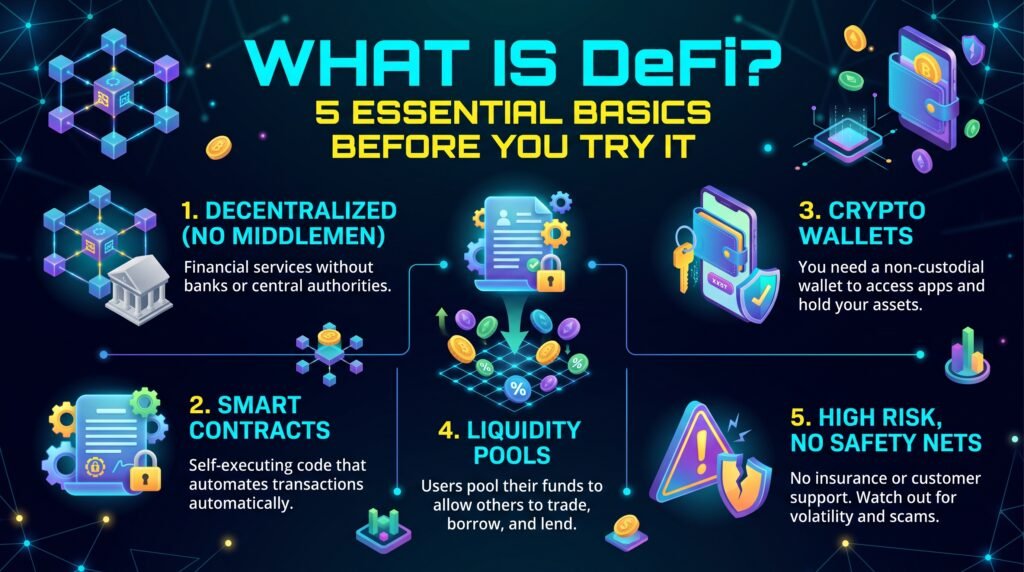
What is DeFi? Short for decentralized finance, it’s a category of crypto applications that let you lend, borrow, trade, and earn interest without going through a bank or broker. Instead, these apps run on smart contracts, self-executing code on a blockchain, covered in more depth in our guide to smart contracts. Before you try it, here are five essential risks to avoid.

This article is for education only and is not financial advice.
What Is DeFi, in Plain Terms?
Traditional finance relies on institutions, banks approve loans, brokers execute trades, exchanges clear transactions. DeFi replaces that middle layer with code. A lending app, for example, matches lenders and borrowers automatically and enforces the loan terms through a smart contract rather than a loan officer. Understanding what is DeFi at its core comes down to this one shift: code replacing institutions.
How DeFi Is Different From a Regular Crypto Exchange
A centralized exchange is a company that holds your funds and acts as a middleman for trades, similar to a traditional brokerage. DeFi instead lets you interact directly with a smart contract, usually from your own wallet, without handing custody of your funds to a company first. Our guide to custodial vs non-custodial wallets explains this distinction in more depth.
5 Essential DeFi Risks to Avoid
1. Assuming you’re always in full control of your funds
Since you interact directly from your own wallet rather than depositing funds with a company, you typically retain control until the moment you actually commit to a transaction, unlike a centralized exchange where the platform holds your assets. But approving the wrong contract can still expose your funds.
2. Ignoring smart contract risk
Every DeFi app is only as reliable as the code behind it. A bug or exploit in a smart contract can lead to permanent loss of funds, and unlike a bank, there’s usually no customer support or insurance to make you whole afterward.
3. Chasing yields that look too good
Interest rates well above what traditional finance offers are often a sign of unsustainable incentives, aggressive risk-taking, or a token designed to attract deposits before collapsing. Extremely high advertised returns in DeFi deserve extra scrutiny, not excitement.
4. Forgetting that transactions are irreversible
Once a DeFi transaction is confirmed, there’s no customer service line to call for a reversal. A mistyped address, an approved malicious contract, or a misunderstood transaction can all result in permanent loss.
5. Assuming regulation will protect you
According to the U.S. Treasury’s own 2023 risk assessment, DeFi carries unique illicit finance risks precisely because it often lacks the compliance checks traditional financial institutions are required to run. Oversight and consumer protections are still catching up to the technology.
Common Things You Can Do With DeFi
- Lending and borrowing: Deposit crypto to earn interest, or borrow against collateral you already hold
- Decentralized trading: Swap one token for another directly through a liquidity pool rather than an order book
- Staking: Lock up crypto to help secure a network or protocol in exchange for rewards, covered in our guide to crypto staking for beginners
Is DeFi Safe for Beginners?
DeFi carries meaningfully more risk than using a regulated, centralized platform, mainly because there’s no company to call if something goes wrong and smart contract bugs are a real possibility. Starting with small amounts, sticking to well-established, audited protocols, and understanding exactly what you’re approving before signing any transaction all reduce, but don’t eliminate, that risk.
Frequently Asked Questions
Do I need a lot of crypto knowledge to use DeFi?
Basic wallet familiarity helps significantly, since most DeFi apps require you to connect a wallet and approve transactions directly, rather than relying on customer support to walk you through it.
Is DeFi legal in the United States?
Using DeFi apps isn’t illegal, but the regulatory landscape is still developing, and some specific activities may carry compliance obligations depending on how they’re structured. This is a complex and evolving area.
Can I lose money using DeFi even if I don’t make a mistake?
Yes. Smart contract bugs, exploits, and project failures can result in losses even when a user follows every step correctly, which is why only using funds you can afford to lose is a common recommendation.
What’s the difference between DeFi and a regular crypto app?
Many crypto apps are actually centralized, meaning a company controls the backend and holds user funds. Genuine DeFi runs primarily through smart contracts, with no single company able to unilaterally freeze or control user funds.
Source
U.S. Department of the Treasury: DeFi Illicit Finance Risk Assessment
Disclaimer: This article is for informational purposes only and does not constitute financial advice. Cryptocurrency investments are volatile and carry a risk of total loss. Always do your own research and consider consulting a licensed financial advisor before investing.