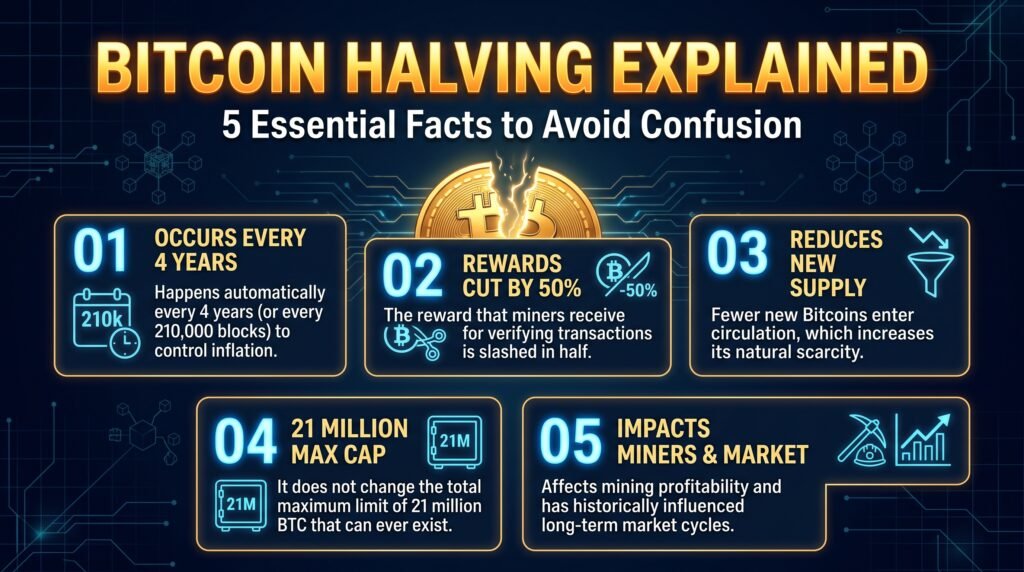
Bitcoin halving is an event built directly into Bitcoin’s code that cuts the reward miners earn for processing transactions exactly in half, roughly every four years. Understanding bitcoin halving helps explain why Bitcoin’s supply grows more slowly over time and why the event gets so much attention. Here are five essential facts to avoid confusion.

This article is for education only and is not financial advice.
What Is Bitcoin Halving, Exactly?
Miners compete to validate new blocks of transactions and are rewarded with newly created bitcoin for doing so. Bitcoin’s code specifies that this reward is cut by 50% after every 210,000 blocks are mined, which works out to roughly every four years. This is bitcoin halving, and it’s one of the core mechanisms that controls how new bitcoin enters circulation.
5 Essential Bitcoin Halving Facts
1. The reward has already been cut multiple times
The block reward started at 50 bitcoin in 2009. It dropped to 25 in 2012, 12.5 in 2016, 6.25 in 2020, and 3.125 following the most recent bitcoin halving in April 2024. The next one is expected around 2028, when it will drop again to 1.5625.
2. There will only ever be 21 million bitcoin
Because the reward keeps halving, new supply keeps shrinking rather than stopping abruptly. The last fraction of bitcoin is projected to be mined around the year 2140, at which point miners will rely entirely on transaction fees rather than new coin rewards.
3. It doesn’t guarantee a price increase
Past halvings have sometimes been followed by significant price rallies, but correlation isn’t the same as causation, and many other factors influence price at the same time. Treating bitcoin halving as a guaranteed price catalyst is a common mistake that oversimplifies a complex market.
4. It directly affects miner profitability
Since miners earn fewer bitcoin per block after each halving, their revenue from mining drops unless the price rises enough to offset it or transaction fees increase. This has historically pushed less efficient mining operations out of the network.
5. It’s publicly predictable, not a surprise event
Because it’s built into the code and based on block count rather than a calendar date, the approximate timing of the next bitcoin halving can be estimated well in advance, which is why countdown trackers exist across the industry.
Does Bitcoin Halving Affect Transaction Fees?
Not directly, but it changes the incentive structure. As the mining reward shrinks over time, transaction fees are expected to make up a larger share of miner revenue. Our guide to crypto gas fees covers what currently drives transaction costs day to day.
How Bitcoin Halving Relates to Mining
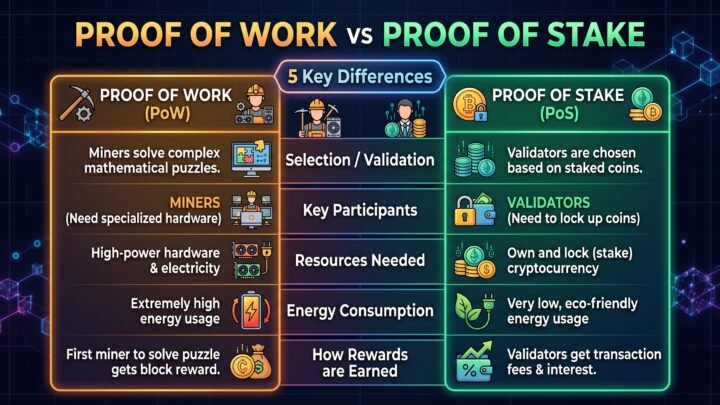
Bitcoin mining itself relies on the proof of work system, where miners compete using computing power to validate blocks. Our guide to proof of work vs proof of stake covers how this consensus mechanism works and how it compares to alternatives like Ethereum’s proof of stake system.
Should You Make Investment Decisions Based on a Halving?
Basing a decision solely on a halving date, without considering broader market conditions, your own risk tolerance, and the fact that past patterns don’t guarantee future results, is generally not a sound approach. Our guide to dollar-cost averaging covers a more measured alternative to timing single events.
Frequently Asked Questions
When is the next bitcoin halving?
The next one is projected for around 2028, based on current block production rates, though the exact date shifts slightly depending on how quickly blocks are actually mined.
Does bitcoin halving happen on other cryptocurrencies too?
Some other proof-of-work cryptocurrencies have similar built-in supply reduction mechanisms, though the specific schedule and reward structure vary by project.
Will mining still be profitable after future halvings?
That depends on bitcoin’s price, mining efficiency, and transaction fee revenue at the time. It’s not guaranteed, and some less efficient miners have historically exited the network following past halvings.
Is bitcoin halving the same as a stock split?
No. A stock split doesn’t change a company’s value or supply economics the way halving does. Bitcoin halving specifically reduces the rate of new supply entering circulation, a fundamentally different mechanism.
Source
Coinbase Learn: What Is a Bitcoin Halving?
Disclaimer: This article is for informational purposes only and does not constitute financial advice. Cryptocurrency investments are volatile and carry a risk of total loss. Always do your own research and consider consulting a licensed financial advisor before investing.